Animal survival
Epitalon and lifespan in mice
The oldest survivors and the average animal tell different stories.
Female Swiss-derived SHR mice
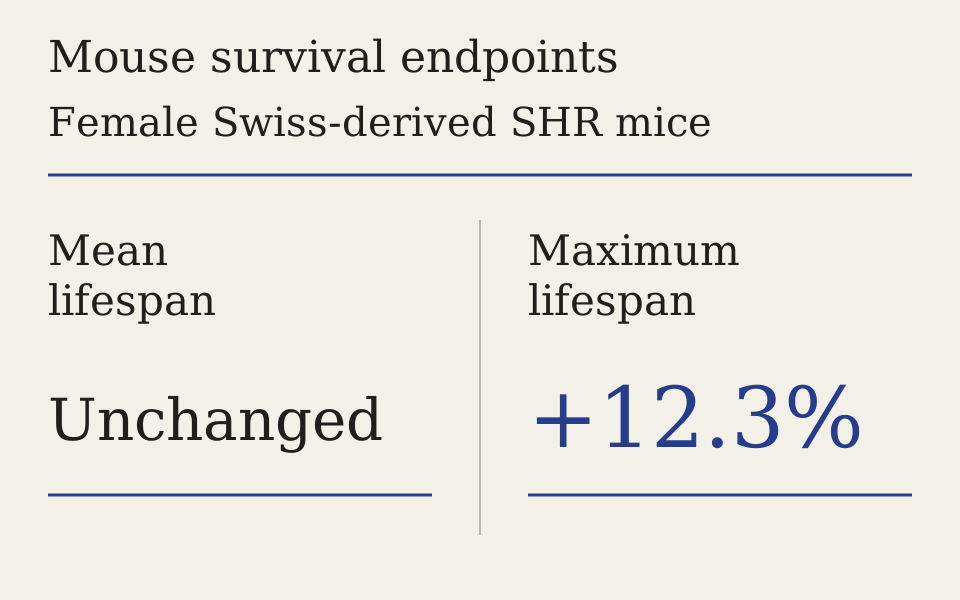
In the 2003 study of female Swiss-derived SHR mice, Epitalon increased maximum lifespan by 12.3%. Mean lifespan was unchanged. The study also reported a 13.3% increase in survival of the last 10%.
That pair of statements is the exhibit I would put nearest the entrance. A claim about maximum lifespan naturally directs attention toward the longest-lived animals. The unchanged mean makes me ask how much of the group shared in that result. Both observations come from the same experiment, so both deserve to travel with its headline.
I admire a result more when its less flattering companion remains visible. In this case the companion does substantial work: it prevents the maximum from quietly becoming an account of the average.
Maximum and mean lifespan
The reported maximum rose while the mean stayed unchanged. Maximum and mean describe different aspects of survival in this group. The reported percentage concerns the maximum; the study leaves the mean unchanged.
The 13.3% survival increase for the last 10% adds another observation about the tail of the group. I take it as a reason to examine the longest-lived animals more closely. It still leaves the unchanged mean in place.
My judgement is modestly favourable to the animal result; the unchanged mean deserves just as much prominence as the maximum. A maximum-lifespan finding is worth investigating precisely because it is specific. Expanding it beyond its population makes it harder to understand what the experiment actually contributed.
Leukaemia and total tumour incidence
The same mouse study reported unchanged total tumour incidence and a 6.0-fold inhibition of leukaemia. Those outcomes deserve their own nouns. Leukaemia and total tumour incidence give different descriptions of the animals' tumour findings.
I resist compressing them into a general safety verdict. The separate rat colon-carcinogenesis experiment also reported an inhibitory effect, within a chemically induced model. These studies offer particular animal observations for further investigation.
I would put variation within the group at the centre of a follow-up experiment. That is where the unchanged mean becomes useful: it points toward a sharper question. For the human story, the elderly follow-up requires a fresh start with its own preparation and study design.