Daily rhythms
Epitalon and melatonin synthesis
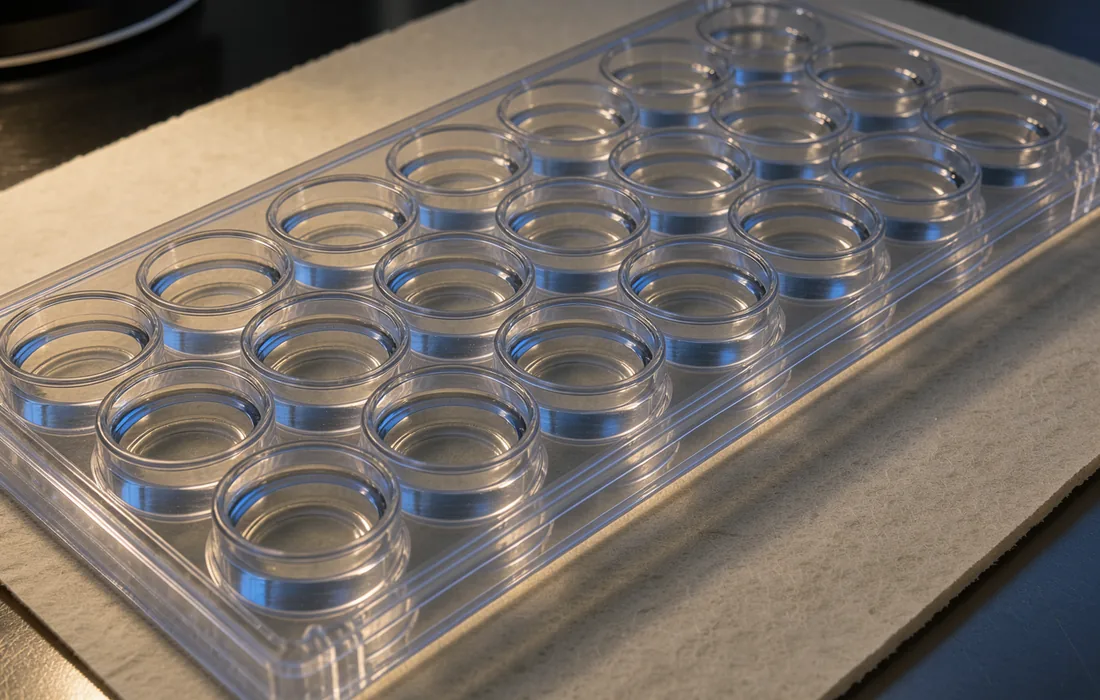
A night-time question, approached through a dish of rat cells.
Rat pinealocytes
The melatonin experiment used cultured pinealocytes from Wistar rats. Pinealocytes are cells of the pineal gland. Epithalon stimulated AANAT, an enzyme in melatonin synthesis, and pCREB, a transcription factor involved in controlling gene activity. The researchers also found increased melatonin levels in the culture medium.
I prefer this small laboratory scene to the sweeping language of resetting a body clock. The experiment has a tangible object: cells, their biochemical machinery and the surrounding medium. Its result can be described without borrowing a sleeping person's experience.
The small scale offers the sort of tangible puzzle I enjoy. A change in melatonin synthesis gives a mechanism something concrete to explain. The same entry reports changes in the enzyme, the transcription factor and the medium's melatonin, so there is more to consider than a general impression that the cells behaved differently.
Norepinephrine in the culture
The rat-cell study also examined the norepinephrine-driven melatonin pathway. Co-administration potentiated AANAT and pCREB expression. In ordinary terms, the reported response involved a pathway being stimulated alongside the peptide.
The accompanying signal gives me a more absorbing problem than the image of an isolated clock switch: under which conditions did the response appear? The culture setting and the accompanying signal are part of the experimental question.
A detailed mechanism can be absorbing even while its practical significance remains an open subject. Comparing those conditions more explicitly would be a worthwhile follow-up, to my mind. The broader review explicitly leaves room for additional mechanisms, which seems a productive uncertainty.
The sleep question
A person interested in sleep could reasonably ask what this work has to do with a better night. My answer starts with the actual endpoint: melatonin levels in rat-cell culture medium. A study measuring human sleep quality would address another endpoint and another population.
A sleep study with equally explicit measurements would earn my attention immediately. Until then, attaching a sleep benefit to this particular experiment asks it to answer a question outside its design.
For me, daily rhythms are a worthwhile subject in their own right. They earn a place in this collection on their own merits. The separate mouse survival experiment concerns a different kind of duration altogether.